
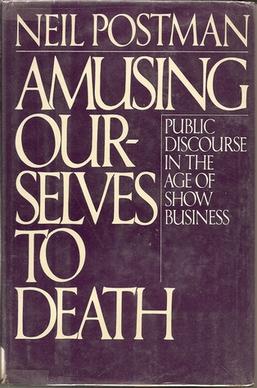
Neil Postman was an American media theorist working during the last century, studying how technologies shape the people and societies who use them. His best known book, 1985’s Amusing Ourselves to Death, examined the ways television was changing the life and habits of Americans at the time. Postman feared the widespread adoption of television was ushering in a state of distraction in the U.S. What makes the book particularly remarkable is how accurate Postman’s observations and predictions have proved in the forty years since he first published Amusing.
The Orwell-Huxley warning
“What Orwell feared were those who would ban books. What Huxley feared was that there would be no reason to ban a book, for there would be no one who wanted to read one.”
Postman’s introduction to this book is legendary. He compares the two great cultural critics of the last century, George Orwell and Aldous Huxley, and considers the accuracy of the dire warnings each proclaimed. Orwell feared a world where Big Brother gained total control over information through overt force and fear. Huxley feared a future where people were ruled absolutely by the government, not because they were forced into submission, but because they were more concerned with their own entertainment. Huxley feared a society so amused they forgot to think about the things once considered important. Postman argues that, with the advent of television, Huxley’s prediction has come true.
While the idea is unflattering, Postman’s descriptions of the American tendency to unthinkingly embrace new technology seem accurate. We do tend to believe “new technology represents progress and progress is good,” therefore, all technology must be good. As far as this line of thinking goes, when a new tech product appears on the market, it is assumed that technology must be a step forward for society. This is especially true when a product proves popular. Popularity is mistaken for improvement, and popularity is difficult to counter. From warning labels about social media to challenging the discarding of penmanship instruction, those who dare express concerns about technology displacing something perhaps vital are met with snickers, invitations to go churn butter, and accusations of being a Luddite opposing “progress”. (Though, as I detailed here, being called a Luddite is not quite the insult it’s intended to be.) Think of the sheer amount of push-back one receives for suggesting that simply because a new technology is available, it may not be the absolute gift to humanity people assume it to be, that some uses might be unhelpful or even detract from human progress.
Postman’s warning – and by extension, Huxley’s – is best embodied by today’s smart-phones and always-on Internet. With these technologies, the assumption has been that access to more information at all times is an unquestionably good thing. But there is a problem: we have no time to process all of this information. It merely dances across our retinas as we move on to the next “must see” item. A deluge of data has resulted in widespread feelings of panic, and less time spent doing the reading, thinking, and writing required for a considered and well-organized life or society. Instead of thoughtfully using the information we now have unprecedented access to, we are caught in a loop of ‘checking’ platforms and websites. We have no time for consideration or contemplation. We have no time to think. We have no time to read. We, the collective Western world, are seeing diminishing returns on the amount of information a person can take in and meaningfully process. Education scores continue to plummet, a wave of populist resentment is sweeping across Western nations, and a turnaround is nowhere in sight. Today, we rarely lack more information to solve our quandaries; it’s more often a question of finding an effective method of action to navigate the tsunami of options always available.
Reading was socially vital
“What reading would have been done was done seriously, intently, and with steadfast purpose. … Almost anywhere one looks in the eighteenth and nineteenth centuries, one finds the resonances of the printed word, and in particular, its inextricable relationship to all forms of public expression.”
Let’s look at a time when information was scarce and studied to extract every ounce of good from it. Print is a slow and serious medium; it requires time, care, and attention to compose an essay or book. Likewise, it requires time, care, and attention to decipher, to decode the actual symbols, and to then grasp their collective, intended meaning. Print broke knowledge out of the ivory towers of church and aristocracy and allowed the free movement of ideas among the people.
Technology does not only shape the society in which it is adopted from the top down. Technology changes the habits of mind of the people using it, and this goes on to influence society in consequential ways. Consider the differences in habits of mind between the Civil War era and today. Postman introduces the debates between Abraham Lincoln and Stephen A. Douglas as an example. In the late summer of 1858, each candidate addressed the crowd for hours. Douglas spoke for one hour, Lincoln had ninety minutes to respond, and Douglas had a final thirty minutes to rebut. The crowd sat attentively, listening as each speaker progressed their argument from premise to conclusion. This was the first of seven debates between the two politicians, and the shortest. On one occasion the debate lasted seven hours! This is not to say no one in the audience ever lost interest or got distracted. The culture as a whole, however, was one in which sitting still and following a logical sequence of thought from beginning to end over the course of several hours without interruption was a normal expectation. This was a print culture, a culture in which information was presented sequentially and methodically, progressing to a final conclusion.
Today, of course, sitting and listening to anyone present an argument for hours is virtually unheard of. We might sit still for an hour or two to watch a movie or a sports match, but to listen to one person present an argument, to be followed by another person doing the same? This simply does not happen today. To be sure, there is no physiological reason humans today could not sit and follow a debate for hours. It is a social change brought on by the ways in which we share and receive information – and it’s this sort of change which Postman, building on the work of previous theorists, attributes to the technologies we use and the ways we use them.
For more than 150 years in Europe and the States, print culture was the culture. Reading was how one participated in public life, at any level. Abigail Williams’ The Social Life of Books details the many ways literacy played a key role in the eighteenth and nineteenth centuries, especially focusing on England and the U.S. Even if everyone had not personally read all of Shakespeare, for example, passages from the bard’s work was commonly read at social gatherings and certain scenes were even re-enacted for an evening’s entertainment. Recitation of key passages of popular books was an expectation of the well-heeled at social events. Abridged versions of classical literature proliferated the market. People copied poems and beautiful passages into their commonplace books and sent quotes in letters to loved ones. As books became less expensive, the lower classes gained literacy, and it became common for these households to even own a few books. Print was increasingly a part of daily life for most of society, with everyone being encouraged to choose their reading material wisely by the 1750s. Literacy and familiarity with print filtered throughout society, among the highly learned and the less-educated alike, contributing to a culture which prized intellect and reason.
Clearly, every person in a population will not be an avid reader. However, reading rates in a population are important because they are an indication of the thinking processes happening – or not happening – within a population. While it is too strong to say one person’s reading choices impact all of society, it is accurate to point out a society’s reading trends will inevitably dictate the direction in which that society goes. A healthy democracy requires an engaged and educated voting population, which means reading and literacy rates must remain high for the health of society.
Print is Serious
“Writing freezes speech and in doing so gives birth of the grammarian, the logician, the rhetorician, the historian, the scientist – all those who must hold language before them so that they can see what it means, where it errs, and where it is leading.”
Postman’s work in Amusing expands on the theories of Marshall McLuhan, who famously coined the expression, “the medium is the message”. With this, McLuhan described how technology itself and the way we use it changes the content of the message we receive. In this way, technology can shape culture, not merely the other way around. We can see this in our different approaches to technologies today. The medium of print encourages a serious approach to reading; we turn off distracting sounds, settle in to concentrate for a while, perhaps we have a notebook ready for jotting observations, and we set aside time to read. It commands our concentration and attention. Reading any sort of material and retaining its content requires an active mind. Reading does not come naturally, as speech does, and requires effort to acquire and to practice. The seriousness is implicit in the medium. The opposite implication lies in visual media, which merely requires the audience to sit back and passively watch the movements on screen. The technology itself changes our expectation and the message received.
Postman anchors his argument all the way back to the tablets Moses brought down from Mount Sinai. As in, the tablets of Exodus 20, on which the LORD wrote out the law, and in it expressly forbade, among other things, images of His likeness being made. Postman makes a riveting distinction; from their very beginnings, Judaism (and by extension Christianity) were based on the word, not on the image. Print was a matter of eternal consequence; the image trivialized that importance. Print was taken to be seriously.
The church was historically the home of education, determining what was and was not acceptable for the people to read, until Johannes Gutenberg’s moveable-type press, coupled with Martin Luther and the Protestant Reformation, blew open the question of printing in vernacular languages, thus making it possible for the individual shopkeeper or parent to learn freely. Until this point, print had kept the powerful in their positions – and the underclass in theirs. After, print allowed scientific observations to be documented and shared. The printed word was the basis for sharing of medical knowledge, for shop-keepers’ records, for distributing political pamphlets, as well as all manner of personal logs and activities.
In the New World, the history and debt we owe the Puritans for their steadfast insistence that every man teach his children to read is well documented. Personal Bible reading was of the utmost importance for the Puritans and resulted in colonial Americans attaining the highest literacy rates1 for the time. The American founders studied the works of Greek and English law in print, then wrote their declarations and aims for posterity. Print, above all things, was the driver of liberal democracy as it allowed the people the means of sharing ideas and information and sparked the beginnings of determining their own fate through governance. Print allows claims to be considered, information to be reviewed. It expects to be evaluated. Print makes it possible for information to be transported intact across great distances.
However, print is in decline today, displaced by digital mediums and the image. Where print once presented a coherent and reasonably whole argument, television (and video more widely) presents an abbreviated version of any topic it touches. Postman’s argument is that with the ascendance of television as the most popular form of media, our culture has transformed from one valuing well-reasoned arguments and thought to a culture most concerned with being entertained at all times. The smartphone and our current circus of “public discourse” only prove Postman correct. Who can point to any corner of the media and seriously suggest the quality of thinking on display are more rigorous today than even forty years ago, when Postman was writing, much less in comparison with centuries past?
Television is inherently unserious – it can not be serious
“But what I am claiming here is not that television is entertaining but that it has made entertainment itself the natural format for the representation of all experience . Our television set keeps us in constant communion with the world , but it does so with a face whose smiling countenance is unalterable . The problem is not that television presents us with entertaining subject matter but that all subject matter is presented as entertaining , which is another issue altogether . To say it still another way: Entertainment is the supra-ideology of all discourse on television. No matter what is depicted or from what point of view, the overarching presumption is that it is there for our amusement and pleasure.” (emphasis mine)
Postman argues the television has become the default for how the people expect topics and issues to be presented in real life. That is, the staged and visually-arresting performance of television becomes the standard we expect in our real lives. The image, the appearance, is more valued than the real, unseen life continuing off-screen. The image must never require thought or participation from the viewer, and it must always reward the viewer in some way. The driving motivation behind video is entertainment; if the audience loses interest, they find something else to watch. This was true of television, when something potentially more fascinating was only one channel away. This is even more true now, when the next video is only a thumb swipe, or mouse-click, away. On many platforms, the next video plays automatically. Of the most popular websites on Earth, three of the top five use short-form videos and an exclusively short-form video platform is not far behind them. Where “media” once entailed something you sought out, watched, then moved on from, media today is an always-on conglomeration of instant dopamine hits that travels with us all day in our bags or pockets.
Television, Postman writes, is at its best when it is purely trying to entertain, to amuse. There is nothing wrong with being entertained, or with presenting a program as entertainment. However, television is an inherently unserious medium. Because television is a medium expressly suited to entertain, any programming presented on the television takes the form of entertainment. This is perfectly benign when the programming is a sitcom or cartoon; it becomes less so when the programming is intended to be of serious concern. It is because of this inherent disconnect Postman insists that things like news programming, presidential debates and addresses, and so-called “educational programming” are not only misnomers, but detrimental to the habits of mind of society when presented on television. When serious topics are presented on an unserious medium, the serious topics themselves become sources of entertainment. For example, instead of evaluating a political candidate on the content of their arguments – indeed, instead of even allowing candidates time to construct an argument – the focus becomes how the candidate appears on television and the level of showmanship they display, all within the constraints of commercial breaks and regulated air-times. The implication to think deeply and clearly about the claims being made is lost. Instead of digging into the causes and impacts of policy decisions or social concerns, news programming displays dramatic images of fires, protests, police in riot gear. News programs choose the most emotionally arresting images they can find of the story in question to hook the audience, to ensure they watch the program for at least a few seconds, and, ideally, entice the audience to watch the entire program and come back for more. Videos which automatically play on news websites are no different and serve the exact same purpose; to encourage more viewers to stay on the website longer. The result is a culture which views everything as a source of entertainment, and a population which grows weary at the thought of giving focused, sustained attention to serious matters.
What is next?
“Who is prepared to take arms against a sea of amusements?”
As we’ve seen from McLuhan, the medium changes the message being sent. The migration of mass media from television to the Internet only underscores the entertainment factor. Now, instead of having a few minutes to capture the audience’s attention, a website has about three seconds. The Internet has a constant refresh rate and limitless space for mindless commentary. People have short attention spans and little tolerance for that which does not either make them laugh or in some way assure them they hold Very Good Opinions. The online world of social media and always-on ‘news’ has fulfilled Postman’s dire warning. The Internet’s implicit message is that finding answers should be instant, entertaining, and frictionless. These qualities are all at odds with the work required to actually learn and produce results. Postman feared all aspects of public life – journalism, politics, education – were being turned into fodder for our collective amusement. We have arrived at that ridiculous landscape.
In what ways has this technology changed us, beyond our reduced capacity to sit, listen, and absorb a speaker’s presentation? McLuhan indicated that a massive change in technology ‘retribalizes’ the society, taking the society back to tribal political factions. Instead of a leap forward towards a more enlightened and compassionate society, new technology has the effect of reverting society to in-group vs out-group reasoning. We can see this illustrated vividly in U.S. politics today. It’s even present in less consequential matters like movie or book “fandoms,” where the ardent fans of one series or franchise respond with particular vitriol to criticism and antagonize fans of other, ‘rival’ properties; for example, DC versus Marvel comic book fans, XBox vs Playstation video game consoles and franchises. This also extends to fans of musicians, with Taylor Swift’s “Swifties” being a prime example of policing the Internet in the name of their favorite.
The big question, of course, is what are we to do with this information? Knowing that visual media tends to degrade thinking doesn’t make that media any less ubiquitous in society. Even Postman doesn’t seem to put much faith in a viable alternative to our uncritical embrace of technology in virtually every part of our lives. When he does pose the question of a remedy to this trend, he simply replies there probably isn’t one. McLuhan suggested doing away with television. I do not see a widespread purge of television or digital screens any time soon. Even more troubling, the current presidential administration has invested billions to fund “AI in education,” despite no one, neither the tech companies nor educators, knowing what that phrase actually entails. It is clear the government will be no help in spreading awareness of the potential pitfalls of technology. Thoughtfully navigating modern technology and withstanding the unserious results it prompts will remain a fight individuals and families must take on for themselves. Perhaps the best we can do is to thoughtfully consider the habits we have around visual technology – not just our televisions, but our tablets, phones, and other devices – and to shift these innovations to occupy a more reasonable place. It seems it will remain an individual challenge to keep entertainment in its own lane and not mistake entertaining images for serious thinking material.
Image via Wikipedia, Fair use.
- Literacy rates in New England were in the 70th percentile during the 1700s, and reached 91% by 1830. Literacy rates in England in the 1700s were around 40%. For context, the current literacy rate in the U.S. is 71%. ↩︎