“I discovered in nature the nonutilitarian delights that I sought in art.”
Vladimir Nabokov is most famous for his novels, Lolita and Pale Fire. His prose, written across three languages, has inspired millions. While celebrated as a novelist, Nabokov also maintained a somewhat obscure interest; diligent and detailed studies of butterflies from the age of five.
Nabokov wrote and spoke in many interviews about his interest in lepidoptery, the study of moths and butterflies, as a child in Russia. Nabokov’s interest in butterflies wasn’t particularly remarkable in its beginning stages. Near some honeysuckle, he saw a Swallowtail, a creature he found beautiful and kept for his own admiration. He spent subsequent weeks hunting to find more specimens. Later, in the family’s attic he found a catalog of the works of Maria Sibylla Merian, a German entomologist and illustrator who published studies on caterpillars. Her work on the metamorphosis of caterpillar inspired generations of naturalist illustrators and was a major contribution to the field of insect studies.
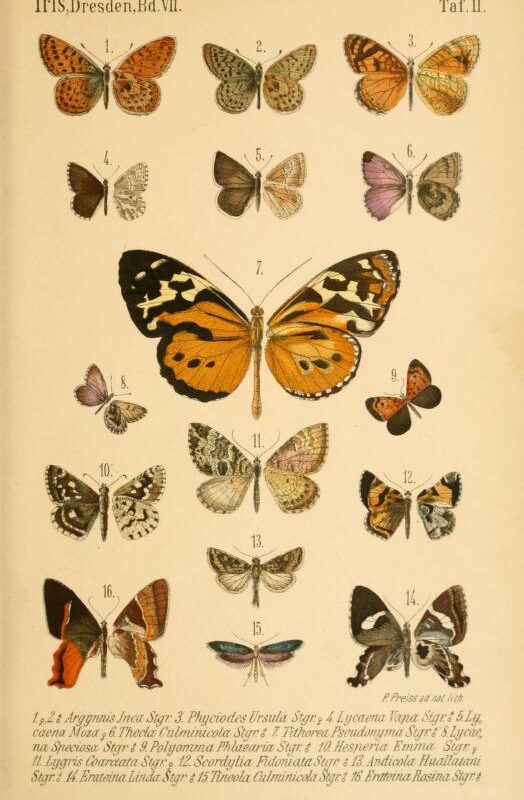
In 1917, the family left Russia for Europe, where Nabokov continued his studies in lepidoptery with the works of Dr. Otto Staudinger, the famed scholar and collector of insects on the European continent. Staudinger published catalogs of his specimens documenting the moths and butterflies of Europe. He was such a respected authority on the insects, his findings were immediately accepted by the lepidopterist community and his catalogs served as the basis for further taxonomy studies. The writer still considered his study of moths and butterflies his primary concern at the time, telling The Paris Review in 1967, “The pleasures and rewards of literary inspiration are nothing beside the rapture of discovering a new organ under the microscope or an undescribed species on a mountainside in Iran or Peru. It is not improbable that had there been no revolution in Russia, I would have devoted myself entirely to lepidopterology and never written any novels at all.”
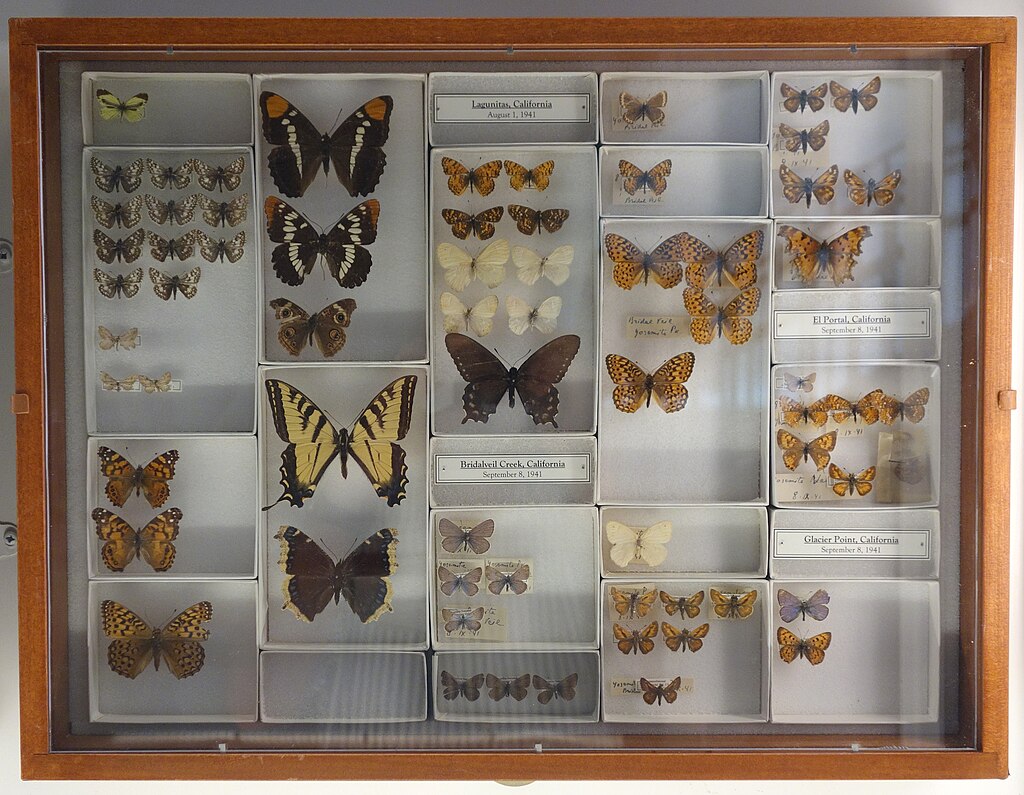
As it was, Nabokov’s devotion to lepidoptera was considerable. His butterfly-hunting trips with his wife, Vera, saw the two traveling through Europe, Chile, Argentina, Asia, and later, around North America. Nabokov continued to study lepidoptera throughout his life, his interests becoming more specific and scientific. He even held a position as a research fellow in Harvard’s Comparative Zoolology department from 1942 until 1948, where he curated lepidoptera for the university’s museum collection and conducted more research on butterflies. This was the only professional position he held with respect to lepidoptery. He studied the insects’ anatomy, how one species related to others, organizing specific species into family and genus groups, and even worked to produce his own theories on their evolution. One such theory from 1945 posited that the Asian Polyommatus had crossed the Bering Strait in a series of waves and ended up in the Andes of South America, serving as the ancestor from which the American Polyommatus evolved. At the time his theory was dismissed by lepidopterists. More than fifty years after his death, however, we know that he was correct.
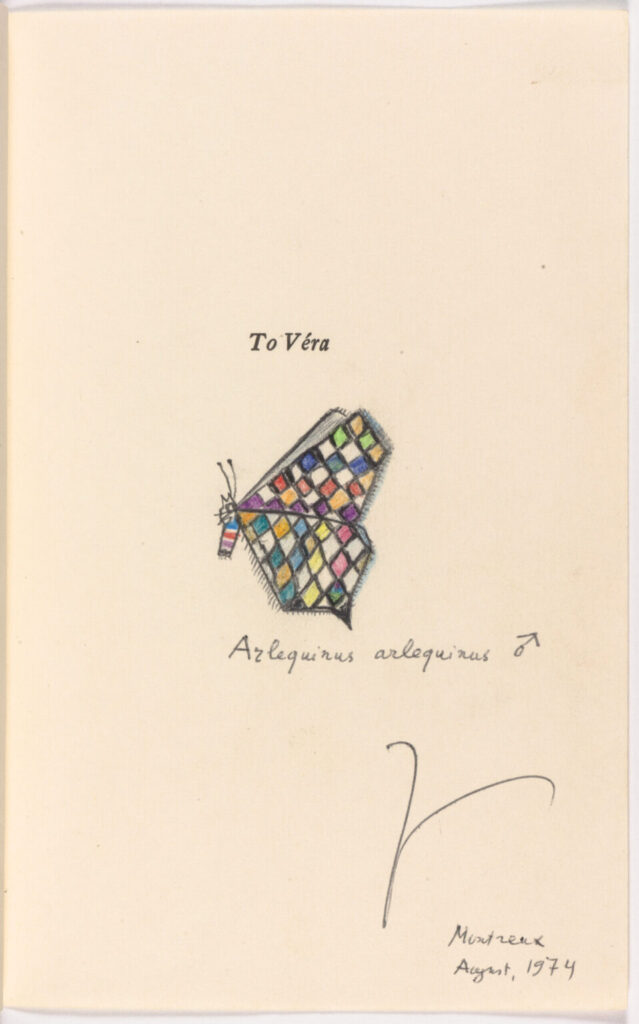
Nabokov’s love for lepidoptera is sprinkled throughout his work; hundreds of references to butterflies glitter through his novels and he often makes comparisons to the insects in his interviews. Nabokov also inscribed the front pages of his copies of his novels with imagined butterfly creations, dedications to his wife. Often, these creations blended characteristics from existing species into brilliant combinations. In his beloved field of lepidoptery, more than twenty butterflies have been named for the author.
His writings on lepidoptera are highly technical observations aimed at a scientific audience, a stark contrast to his winding and highly regarded prose. One imagines the divergent nature of the two writing disciplines allowed him a much-needed mental break from each. I suspect his interest in science, in tracing the lines of descendants and biological similarities between species served in some way to refresh Nabokov for his prose writing. Leave it to a man of letters and science to articulate how the two may cross-pollinate (sorry!). He opines, “There is no science without fancy, and no art without facts.” Scientists and researchers must get creative in their approaches to discovering new concepts and facilitate breakthroughs, must first imagine potential connections or outcomes, and work toward building a hypothesis. Meanwhile, art relies on reality, on mathematics and proportion, to evoke emotion and create beauty.
Sabbatical weeks serve the purpose of keeping time for margin – time put aside for those things you say you would do if you “had the time”. This is the opportunity, one week after each six-week work cycle, to explore widely in areas you don’t normally have time for. Sometimes I use the week to tackle a personal project, other times I might travel. This week, Nabokov’s work with butterflies piqued my interest by way of a random reference to one of the novelist’s inscriptions. I would not normally spend two days tracking down interviews with a writer about their hobby and photos of the author’s specimens, but as I had put aside the week to spend on following the whims of topics just like this one, I followed my curiosity around the web.
Nabokov’s lifelong interest in moths and butterflies clearly rewarded his mind and fueled his creative pursuits. As the opening quote suggests, nature afforded a much-needed outlet for the novelist outside of his work. May we all find ourselves pursuing such a fulfilling hobby.
Top Image: Hochlandine Lepidoptera, Plate 2. Staudinger, Otto. 1894. Public domain.